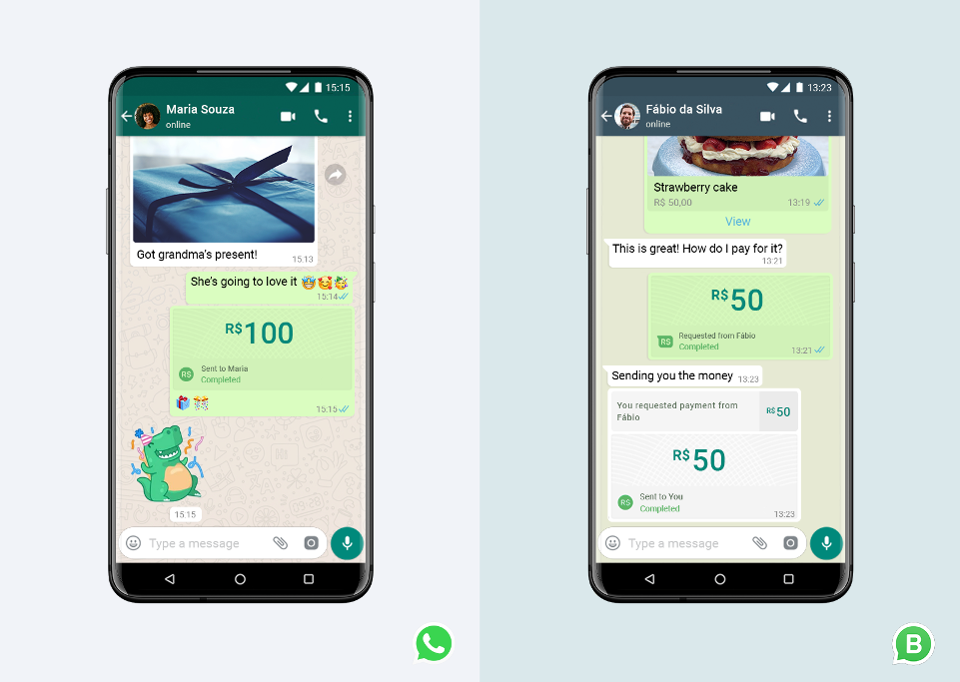
WhatsApp launches new payment feature
WhatsApp has just pressed go on a big new feature: person-to-person payments. It’s just gone live in the past few hours, though only in one country right now: Brazil.
In a post on the WhatsApp blog, the company has announced that digital payments for people and small businesses have just started. This is far from the only update from the popular app — you can read more about recent improvements in Forbes contributor Zak Doffman’s excellent post here.
June 18 update: More details have since come to light about the payment system. For a start, the reason for Brazil being the first place to gain the capability is less surprising given the fact that it’s the app’s second-biggest market — it has 120 million users, around half of the country’s population of 212 million. Its biggest market is India, with 400 million users, around a fifth of the total 2 billion plus WhatsApp users. Since the announcement, WhatsApp Chief Operating Officer Matt Idema Idema said, “We think we can help grow digital payments, help grow the digital economy with small businesses, and help support financial inclusion.” While he didn’t specify which countries, Facebook has previously made clear it wants to make it possible for its users to send messages between its apps, which include WhatsApp, Facebook and Facebook Messenger, and when that happens, they’ll be able to send money between the apps as well, which will be a great benefit. Idema also said that the roll-out may help those in lockdown during the Covid-19 pandemic: “We can’t have the kind of interactions with each other that we normally would, if you want to lend someone cash or if you want to buy something from a local business.” The payments will be completely free for users, both for sending money to friends or to pay a business for goods or services. There will be a fee charged to business owners when a purchase is made. So, it was necessary to partner with a payments company. WhatsApp had said that it was working with Cielo, the largest payments company in Brazil, to process transactions. Now we’ve learnt that since the news was announced of the service, Cielo stock jumped around 35% while rival payments companies’ stock fell, though by smaller amounts. Back to why this development is so important. Business Insider has claimed that WhatsApp may choose next to go to the countries where its user base is large. In 2019 the biggest number of users after India and Brazil were the U.S., Indonesia, Mexico and Russia. in an interview with Reuters has said that expansion to other countries will come soon, which was not known when the service was announced.
Well, Brazil is only the first step, obviously, and although no promises have been made of the feature making its way north to the U.S. or to other countries, it’s highly likely it will.
And it mirrors the way WhatsApp became so dominant in the first place: its multi-platform presence. Brilliant though the Messages app on iPhone is (and even though it’s probably about to see a big upgrade announced by Apple in the coming days), its best experience is across Apple devices. Features such as invisible ink text, animated balloons and more are only visible on iPhone and iPad, for instance.
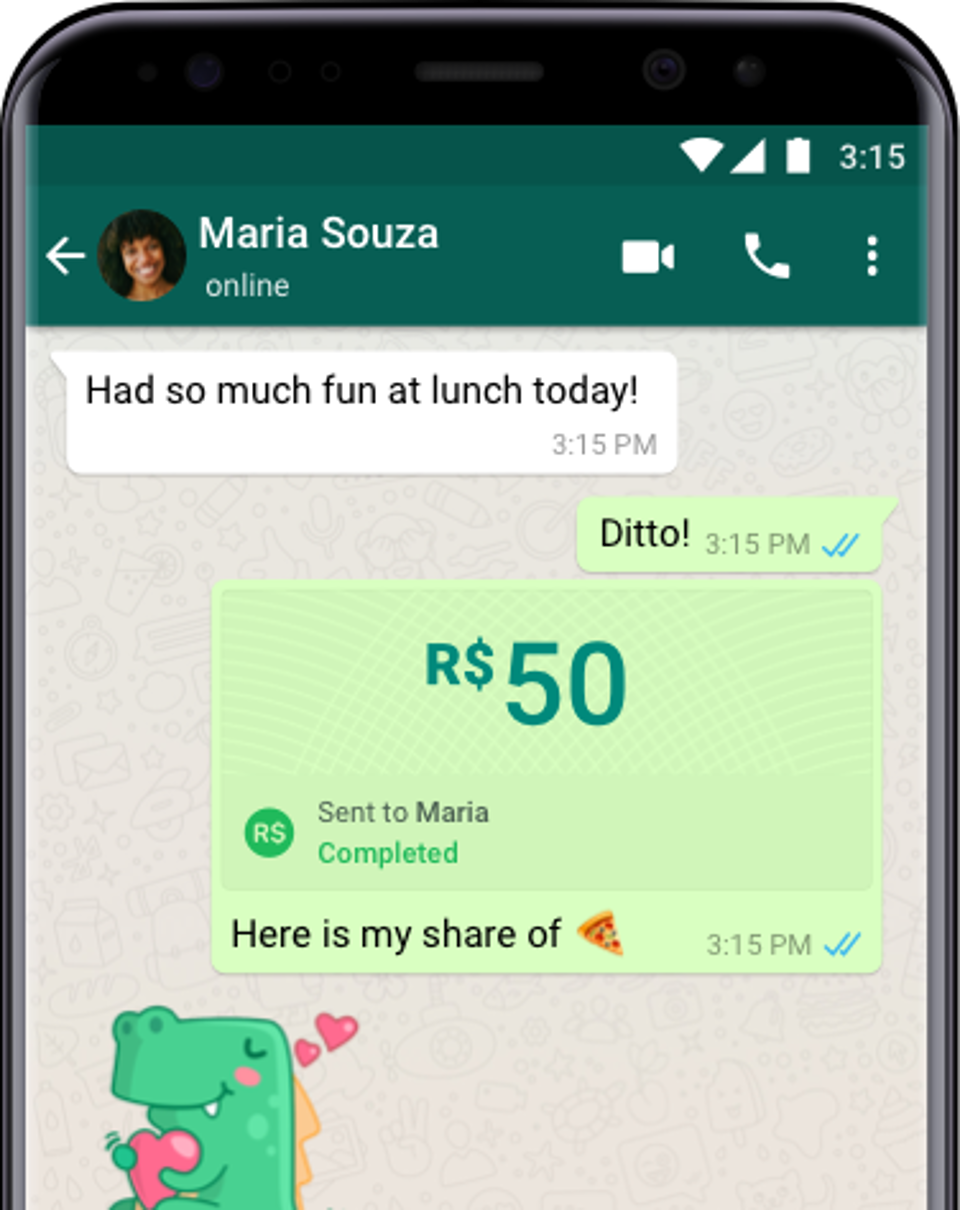
WhatsApp payments complete with celebratory dinosaur
WhatsApp
But WhatsApp? Well, that’s designed so it looks pretty much identical on every platform, so you don’t need to know which friends use an iPhone and which an Android handset before you send your message — everyone will be able to see it in the same way.
So, the addition of payments is a big change. Apple’s own peer-to-peer payment system, Apple Pay Cash, is only available between Apple accounts.
With Whatsapp’s digital payments, you’ll be able to make a purchase without leaving the WhatsApp chat. The company says that sending money to loved ones will be as easy as sending a message, pointing out that at the moment that will be especially important while people are separated from each other.
Initially, only certain debit and credit cards are supported, though the company says it has “built an open model to welcome more partners in the future”.
Security rests in the fact that you’ll need to use a six-digit pin or fingerprint (or other biometric authentication) to complete transactions.
The news is surprising because it had been assumed that WhatsApp would debut this feature in India as it has been testing payments there for some time.
The system is enabled by Facebook Pay, which is already live, in a small number of countries, including the U.S. and U.K. But its fully-featured arrival on WhatsApp will arguably make a bigger difference, especially when it arrives in more territories.
Visa also announced today that it is involved with Facebook to make the payments feature happen, using Visa Direct, the company’s push-payment technology and something called Visa Cloud Tokenization which is a security capability from Visa that removes sensitive payment information from transactions by converting data to tokens, which are then stored securely. Visa says this token framework technology removes risks around data protection and reduces unnecessary steps for the consumer.
Originally published at https://www.forbes.com.
Comments
Post a Comment