
Ransomware Actor Hit Insurance Giant AXA Following Decision to Stop Ransomware Reimbursements


  • The ‘Avaddon’ group has hit AXA Asia only a week after the firm decided to stop paying ransomware actors.
  • The hackers claim to have stolen 3 TB of sensitive documents from the firm and already leaked several.
  • AXA threatens to create a precedent in the field, closing the tap for crooks who targeted insurance-covered firms.

Only a week ago, international insurance giant AXA decided to halt ransomware crime reimbursement in France, with the plan being to expand this strategy globally. AXA justified this by putting forth the ethical aspect of providing financial support — and thus incentive to ransomware gangs, only to see them pullulate and grow stronger.

Today, the ransomware group Avaddon has announced the victimization of the AXA Group and gives the company 240 hours to communicate and cooperate with them. If that doesn’t happen, they threaten to leak 3 TB of sensitive data, allegedly including the following:

  • Customer medical reports (included HIV, hepatitis, STD, and other illness reports)
  • Customer claims
  • Payments to customers
  • All customers IDs
  • All customers bank account scanned papers
  • Hospitals and doctors reserved material (private investigations for frauds, reserved agreement, denied reimbursement, contracts, reports, ID cards, etc.)
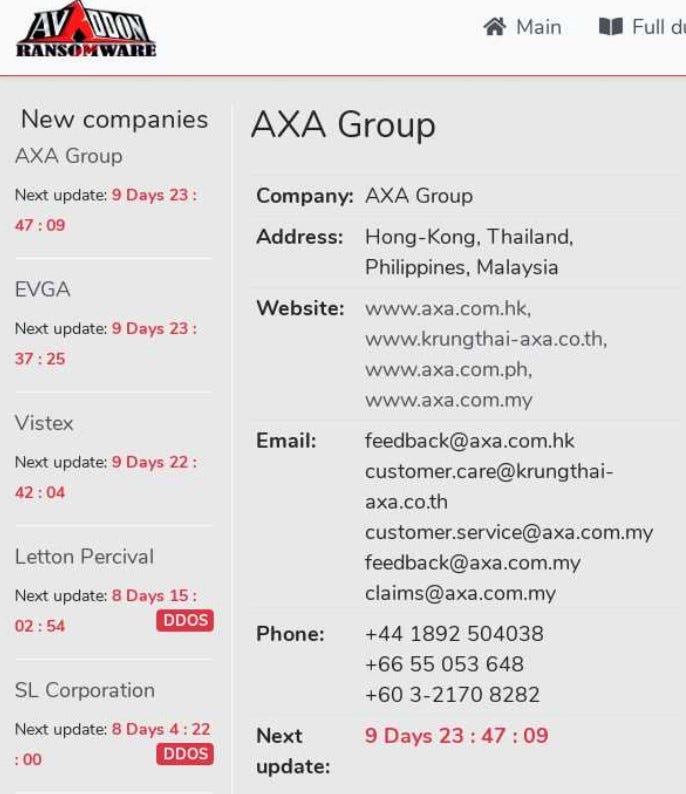
The above concern AXA Asia, comprising the company’s Thailand, Philippine, Hong Kong, and Malaysia-based operations. We have checked the corresponding websites, and they seem to be down. This could be either due to the effort of the local IT teams to contain the infection or due to DDoSing that always accompanies Avaddon’s assaults. Also, the group has leaked several sensitive documents on the extortion portal, many of which feature AXA’s letterheads and stamps, so this appears to be valid.

There is no mention of the attack being the result of AXA’s decision to stop paying ransomware actors, but no one can ignore the strong link here. It could be just a random occurrence, as ransomware groups are hitting tens of large groups every day, but the news on AXA must have drawn the attention of ransomware actors nonetheless. It is, however, improbable that attacks like this one will have any effect in changing AXA’s mind on the matter.

Experts in the field of insurance have estimated that AXA’s move will set a precedent and stated their belief that more firms will follow the same example. After all, there’s pressure from governments to stop this practice, even if paying ransomware actors remains in a gray legal area. Most importantly, though, having ransomware insurance coverage is making you a target for ransomware attacks, creating a negative incentive.

Originally published at https://www.technadu.com on May 15, 2021.

Comments

Popular posts from this blog

Google can now help you figure out that song stuck in your head - all you have to do is hum (or whistle) into your phone

  Google just launched its “hum to search” feature, which allows users to hum, whistle, or sing for 10–15 seconds in order to identify a song. The feature currently works in 20 languages, and Google hopes to add more. Google has finally launched the perfect feature for when a song is stuck in your head but you don’t know any of the words. “Hum to search” launched today on both the Google app for iOS and Android, according to Google’s blog, The Keyword. Users can also whistle or sing directly into the mic to identify a song. The technology works like this: the user can hum (whistle, or sing) for 10–15 seconds, and then Google’s technology takes the song’s melody and turns it into a numbers-based sequence. From there, the sequence can be used to “identify songs based on a variety of sources, including humans singing, whistling or humming, as well as studio recordings,” according to Google’s announcement. The sequence also strips away any other outside noise, like accompanying instru...

Ransomware's Dangerous New Trick Is Double-Encrypting Your Data

  Ransomware groups have always taken a more-is-more approach . If a victim pays a ransom and then goes back to business as usual-hit them again. Or don’t just encrypt a target’s systems; steal their data first, so you can threaten to leak it if they don’t pay up. The latest escalation? Ransomware hackers who encrypt a victim’s data twice at the same time. Double-encryption attacks have happened before, usually stemming from two separate ransomware gangs compromising the same victim at the same time. But antivirus company Emsisoft says it is aware of dozens of incidents in which the same actor or group intentionally layers two types of ransomware on top of each other. “The groups are constantly trying to work out which strategies are best , which net them the most money for the least amount of effort,” says Emsisoft threat analyst Brett Callow. “So in this approach you have a single actor deploying two types of ransomware. The victim decrypts their data and discovers it’s not act...

WhatsApp Users Exchanged Over 100 Billion Messages on New Year’s Eve, A New Record

WhatsApp is one of the most widely used communication apps on the planet and as such, clocks an insane number of messages and media exchanges on a daily basis. But the New Year's Eve broke a record that has been standing since WhatsApp's debut a decade ago. WhatsApp has revealed that users exchanged over 100 billion messages on New Year's eve. And out of that number, more than 20 billion messages were shared by Indian users alone. Moreover, around 12 billion out of the 100 billion+ messages shared on the platform were images. WhatsApp wrote in a press release that over 100 billion messages were shared globally on December 31 in the 24-hour duration leading up to the midnight of New Year's Eve. This is a record-breaking volume and is the highest number of messages exchanged in a single day ever since WhatsApp kicked off its services ten years ago. Out of those 100 billion+ messages shared on New Year's eve, WhatsApp says over 12 billion were images. Meanwhile...